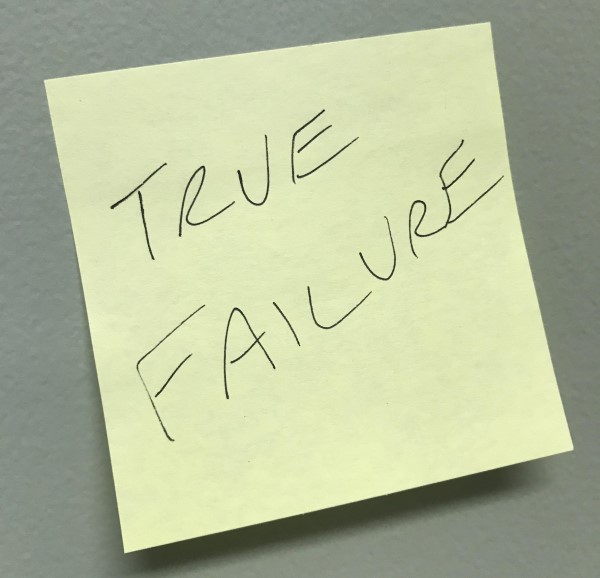
There are certain habits or mindsets that make failure virtually inevitable. Whether in relationships, careers, tasks, or any other life endeavor, any one of these habits – failure to act, failure to adapt, failure to communicate, failure to leverage failures – can negate success.


Failure to Act

If you don’t try, nothing is going to happen. Makes a lot of sense. But what may happen is oftentimes the very reason we fail to act. Taking action means committing to whatever results may occur. If we focus on the potential for failure, not acting seems logical to avoid the potential pain. Unfortunately, by avoiding what could be a failure, we negate any chance for success.


Failure to Adapt

Change happens whether we want it or not. Resistance to change is ultimately about fear that with change comes the potential for failure. Pick the reason: “I’ve always done it this way,” “I’m too old to try that,” “I like the way things are,” “I know what I am doing.” Even when working toward a goal we sometimes ignore the need to adapt along the way. There is a false sense of control in staying the course. The reality is that failure to adapt is the ultimate surrender of control. No control means no chance for success.


Failure to Communicate

We fail to approach the boss about a promotion because we are afraid of what he will say. No promotion comes. We fail to tell our spouse how something they do really bothers us. We resent those actions. We fail to tell friends we need them when we struggle. We struggle alone. We fail to tell the truth when we mess up. Fear of being caught consumes us. We don’t communicate because we don’t want what we communicate to fail. And it certainly can. Yet, not communicating is almost always going to lead to failure to get what we need and want out of life


Failing to Leverage Failures

In 1968, 3M scientist Spencer Silver was tasked with creating a high-strength aircraft construction adhesive. His initial formulations led to a weak, pressure sensitive adhesive that was shelved out of failure. It took almost a decade of attempts by Silver to convince management this adhesive had value. After several reformulations, they found that the adhesive would stick to pieces of paper that could be easily removed from surfaces with no residue. In 1978, 3M began selling Post-It Notes. Enough said.

The irony is that these routes we take to avoid failing are not only limiting success, they are direct paths to failure. Success is not inevitable in anything. Success is only possible, though, if we act, adapt, communicate, and leverage our failures.

Part 3 in a series on The Failures that Lead to Success.

Part 1: Redefining Success and Failure

Part 2: The Necessity of Failure

Part 3: True Failure

In high school, my friends and I hung out occasionally with a car mechanic and amateur racer. He was fond of saying, “If you’re not running off the track every once in a while, you’re not driving fast enough!”

This phrase came in handy when I went to work for an entrepreneur just after graduating college. He was continually throwing around business ideas and we moved forward with a good portion of them. All were intended to move the company further forward or into more lucrative ventures or gain a better control of the work we were doing. They were success-oriented and success-intended. And we failed at probably half of them.

I have worked places where failure was frowned upon and known people frightened of failure of nearly any kind: relationships, jobs, finances, you name it. They are frightened because failure doesn’t feel good. And they are correct.

The problem is when failure is seen as an indication that one is unworthy, damaged, or inadequate. Risk is avoided and success is suppressed. You get around the track without incident but you are not in the race.

Learning that failure is necessary for success has been invaluable for me both professionally and personally. I have had many failures in both realms. Some were rather spectacular in their scope and degree. Some created major shifts in my life’s direction. Some were fantastically productive in the end. Some may still be playing out. All have pushed me forward.

I am certain without the risks taken and the failures along the way, the successes never would have been possible. Failures may be difficult, discouraging, and painful but for life to be all it can be, they are absolutely necessary.


Part 3 in a series on The Failures that Lead to Success.

Part 1: Redefining Success and Failure

Part 2: The Necessity of Failure

Part 3: True Failure

A sense of failure is by far the most common theme I hear from my clients as a counselor. When things don’t work out the way we plan or hope or work toward, it can create great tension and despair.

I have noticed that the perception of success or failure is mostly determined by the end result of our actions. More often than not, the effort and commitment put in is overlooked or negated by the results.

I wonder sometimes if we focus too much on the outcome of our actions rather than the actions themselves.

I recently watched the documentary ZZ Top: That Little Ol’ Band from Texas on Netflix. One of their first gigs was in Alvin, TX where they hoped for a sellout but half-capacity would have been sufficient.

When the curtain opened on stage, there was one guy standing in the room. One.

The guy turned to leave just as they started to play. They stopped and encouraged him to stay. They played their set. During a break, they talked with him and bought him a Coke for staying. Then they got back on stage for an encore. An encore, for one guy.

Here was the lesson for me: They were there to play music and that guy was there to hear music. They followed through with exactly what they were there to do. The ‘failure’ in terms of audience figures was not theirs to own but the success of completing the task of playing for an audience was.

I was reminded that we can only control what we are tasked to do. Results are influenced by our effort and commitment, but are not a guarantee. If we concentrate on our task, put all our efforts in, and persevere through the circumstances that arise, we have succeeded.

I wonder if I would have let that one guy in the audience leave when he turned toward the door. Billy Gibbons, Dusty Hill, and Frank Beard simply carried on with what they were there to do.

I also wonder if I would have put down the guitars and drums after that show and sought another career direction. Gibbons, Hill, and Beard continued on. I never would have guessed, though, this bit of trivia presented at the end of the documentary: “ZZ Top is the longest surviving rock line up of all time.”

I have come to believe that success or failure is in the actions we can control. The results may not meet our hopes or expectations. What matters is our commitment to the task at hand, putting in our best effort, and persevering through the process.


Part 3 in a series on The Failures that Lead to Success.

Part 1: Redefining Success and Failure

Part 2: The Necessity of Failure

Part 3: True Failure

I have become weary with all the memes bemoaning the year 2020. Everyone has their own perspective, I know, but when I read the memes, I instinctively recoil at the premise that this has been a year we should just write off.


To be sure, 2020 is one of unimaginable heartache, suffering, loss, challenge, and soul-searching. There is no established measure for the disruption imposed, the devastation wreaked, or humility required. There are many among us for whom we need to pray for strength, support wholeheartedly, and love incessantly.


I guess what bothers me about those 2020 memes is the implication that all is lost. While recognizing that I have been spared the worst of the times, I cannot escape the great personal fulfillment found within the chaos. I was sitting by my son when he learned to pronounce words, read sentences, and read a story. I have supported my wife as she became an online teacher. I had time to design and hand build a play set that turned out pretty darn good. I created the michaelswords.com website for my writing and this blog about purposeful life. I picked up my guitar for the first time in 10 years. I created a website for my brother’s beach place. I have had lunch nearly every day with my family. I have had time to think.


My friend David once told me, “Nothing unexpected or new happens in the day to day.” That really resonated with me. I relish change, have to be moving and doing, and crave new experiences. I tend to thrive when there is a little chaos. I sometimes create interruptions to keep things interesting or find better paths (apologies to those for whom I owe them).


The unexpected and new tend to happen in the interruptions in life by definition.  But unexpected and new doesn’t necessarily mean bad. In most instances, the good is there for the taking.


I have been captivated by Ricky Gervais’ Afterlife on Netflix (To those offended by vulgar language: This is not the show for you.). His character struggles with the heinous interruption of the untimely death of his wife. Through his struggle to live on, he embraces an unfiltered honesty that forms unusual and unexpected relationships, imparts wisdom to those around him, and pushes others to open their lives.


My response to those memes is this: Even in the worst of interruptions, there is a possibility of blessings. They are there if we look for, create, and embrace them.


#purpose #purposefullife #interruption #2020 #afterlife #blessings #unexpected

We recently decommissioned our clothes dryer that was purchased by my grandmother in the early 1980’s. Our entire marriage, my wife has dropped hints (begged, pleaded) that it was time for a newer model but I simply ignored her. If there was a clear case of perseverance and dedication, this dryer was it. I wasn’t giving up on it since it hadn’t given up on me.

As I was dismantling it to bring it up from the basement, two perfectly spherical, inch-round lint balls dropped from within the drum tumblers. Besides amazement at their perfect shape, I was struck that over 35 years of laundry history was contained within the tightly formed balls.

Traces of the lives of my grandmother, her second husband, other family members, various roommates, my wife, and my child were within those spheres. That machine has been hauled with me to Hillsborough, Durham, and Winston-Salem, NC and Ponte Vedra Beach, FL. That dryer has been in my life through several career changes, graduate school (twice), marriage, divorce, marriage again, and fatherhood.

The fibers in those small, round balls weave the tail of my adult life.

I am not one for nostalgia. Life happens and you move on. That is one of the reasons why I decided on a blog that focuses on purpose and meaning in life. From my feet forward is where I prefer to live life.

Holding these lint balls in my hand, I realize that purpose in life is just as much about what’s behind as it is what’s ahead. I firmly believe that where I am at any given moment is necessarily tied to all of where I have been. Change one thing and I am in a very different reality.

Occasionally my thoughts do wander backward to whether I could/should/would have done something different, better, or more rewarding. That’s my cue to look around me. Though everything is never fully the way I want them to be, I think of my wife, my son, and some of the people I have encountered. Those elements of the present reveal that the past has been purposeful and is filled with meaning.

I put those lint balls in my desk drawer. I just couldn’t throw them away.

Maybe every once in a while when I am in coulda-woulda-shoulda mode, I will put them in hand and examine the fibers for all the been theres, done thats, and happenings that led to where I am.

I didn’t write a post last week. I thought of several ideas which will come out at some point, but nothing seemed right. I’ve figured out where the block lies: I think I made a bad decision. Perhaps two.

Sure, I make countless bad decisions throughout every day. Bad decisions are part of the normal course of breathing. This particular decision is one of the big life areas so it isn’t exactly every day and its implications could be bigger than most.

I’ve been here before, too. Right out of counseling school, I couldn’t find a position I wanted in the area I wanted. Staring down a draining bank account, panic set in and I ended up taking a job I never envisioned in a juvenile detention facility three states away. I knew full well it was not a good idea but easily allowed denial to overcome realism.

It lasted about five months. I liked the people I worked with, didn’t mind where I was working, and felt good about the work I was doing with the young men. But it wasn’t what I had in mind, I was totally on my own, the pay was paltry, the cost of living was even worse. And I was bored and lonely.

Even still, I look back on the peripheral effects of that decision with appreciation. Nothing will teach you more about the human condition, bad and good, than working with 11 to 13-year-olds who end up in prison. I lived in an extended-stay Motel 6 for a month where all you had to do to be accepted was shout “What’s up” to the guys leaning on the second-floor railing, respect other’s laundry, and give a quick upward nod to everyone who passed. I learned to force myself to get out and do things – alone.

Was taking that job a bad decision? If not making a well thought out decision is bad, then yeah. But if I look at the context around that decision, it’s hard to say it was so terrible. I constantly glean insights from the life lessons of those five long months.

Whatever comes of the decision I have at hand, I imagine there is a lot to take from it as well, both bad and good.

What insights have you taken away from your bad decisions?

My friend Erin recently posted about receiving her long-earned, much deserved tenure as a professor. In the post, she confessed her hesitancy to broadcast it for fear it was somehow not important, relevant or ran counter to the prevailing mood during this time of COVD-19 and stay-at-home orders. My reply? We absolutely should be sharing these moments of joy at a time like this.

I firmly believe that even during the darkest moments of life, there is purpose and meaning, joy and hope. Don’t label me an optimist; sometimes I am quite the opposite. Instead, it is the realist in me that sees that practically there can always be something gained during times of profound challenge, loss, and suffering.

If you haven’t yet caught on, this blog focuses on my personal pursuit of purpose and meaning in my own life and the lives of others. Pay attention and you will find that I am a big fan of neurologist and psychiatrist Viktor Frankl, author of Man’s Search for Meaning.

One of Frankl’s keys to finding purpose and meaning is the act of suffering. Frankl contends, “If there is a meaning in life at all, then there must be a meaning in suffering…Without suffering and death human life cannot be complete.” Meaning may come from the suffering itself, the way sufferer or others respond to it, or in the attitude we choose in dealing with the suffering and its aftermath. It is important to know that Frankl’s first wife, father, mother, and brother were killed in Nazi concentration camps. Frankl himself was one of only a handful who survived Auschwitz.

In just the past seven days, my friend’s career accomplishment, discovering that a friend with whom I was close in college just moved nearby, the birth of a child by a colleague, and helping my child learn to read his first sentences have all brought me a sense of meaning. COVID-19 or not, that is a pretty wonderful week. I celebrate these bits of joy within the darkness.

What have been your moments of joy this past week?

My five-year-old is the funniest person I have ever met. I pride myself on quick, dry wit and don’t find just anything funny. He is my son so I am biased, but I cannot claim to have passed on to him the impeccable timing, opportune delivery, and precision wording that he possesses. Did I mention that he is five?

We were in the car on the way to his preschool one morning when they were predicting The Great Snow of 2018. I told him how exciting it was to be in our new house with a steep driveway we could sled down. I told him I thought we could sled down the driveway, across the road, and down the street with the hill in front of our house. In a judgmental and angry voice, I hear, “Daddy, you’re telling me dangerous things!”

Of course, I did the responsible thing as a father. I explained to him how there would be few cars out and even if there were, we would watch for them. Everything would be OK and safe. There was a long pause.

In a concerned and soft tone, he says, “Goodbye, Daddy. I’ll miss you.”

I absolutely howled. I told my office colleagues that morning that at not quite four years old, I had taught my son everything he needed to know in life. You cannot train that kind of sarcastic humor.

Laughter is the fertilizer of life. Laughing is at the heart of the best that life has to offer. I believe a great number of our personal and societal ills are exacerbated by a lack of laughing at our very own existence.

I am blessed beyond all imagination to live with someone who makes me laugh louder and harder than I have ever laughed. His humor keeps me grounded. Jimmy Buffet is right: If we couldn’t laugh, we would all go insane.

I was installing a railing on our basement stairs when my five-year-old came bounding down singing, “Welcome to my dad’s world, where everything is frustrating!” Unwelcome to hear, but funny. And also, very true when it comes to working on the house.

What you need to know here is that I am a counselor. I am supposed to be educated in how to temper unhelpful emotions. I am supposed to be trained in all the tools one needs to manage themselves to a peaceful existence. I am supposed to exude a calm presence all the time. So says my wife.

And yet, I can’t get this #&%! measurement right on this wall!

I am not a counselor who claims to have all the answers and knows some great secret to having a care-free life. I often cringe at lists written by ‘experts’ as the be all, end all strategies to a wonderful life.

What I find is that if most of us do just a bit better here and there, our lives can be enhanced exponentially. That which is better for us spills over throughout our lives in ways we cannot envision.

I am certainly not going to confront counseling clients the way my boy did, though I wondered for a moment how effective it might be. His words, comedic in delivery while slightly cutting, opened me to an obvious area for improvement and how I might be a slightly better me going forward. What I hope is that he will see me become a better dad because of his humor…and honesty.

According to Britannica, coronavirus particles measure about 120 nanometers in diameter. To put that into perspective, that means over a hundred million coronavirus particles can fit on the head of a pin. And yet, in the U.S. alone, these little guys are responsible for hundreds of thousands of infections, thousands of deaths, 95% of the country under stay-at-home orders, millions unemployed, and thousands of businesses facing crises of existence.

I don’t know about you but that certainly puts life into perspective for me. It can be frightening to think that something we cannot see, touch, or smell can have such an effect. At least until it is put under an electron microscope, the only way we even know things like this exist is by the effect they have. In other words, it is not the virus itself but its purpose that packs the punch.

It is easy sometimes to think of ourselves as insignificant in the grand scheme of life. Several weeks working, eating, sleeping, playing, and everything else from our 6/10ths of an acre in Lewisville have done nothing to dispel this notion. But what the diminutive coronavirus reveals is that significance is not measured in size, shape, state, or length of existence, but in the role played within that existence.

Once again, I am reminded that life is a much bigger picture than I can ever imagine. Rather than overwhelming my importance, I see that vastness as elevating the importance of my being intentional in the role I play. It is my hope that on the other side of this, we all seek with intentionality the role we can play in the infinite picture of life.